
What is are considered wine tourism activities? And, which attributes really matter to bring us satisfaction? There has been a huge effort in trying to understand the “Behind the scenes of a Wine Tourism Experience”. What actually makes wine tourists happy and most importantly, return to the cellar.
“the success of a wine tourism experience depends not only on the quality of the wine being offered but also on the way it is offered for sale within the cellar-door environment.”. Martin et al (2004)
We have seen that wine tourism is focused on 4 realms, which together, define the sweet spot of a wine tourism experience. But, what are the attributes that define an enjoyable wine tourism activity? Which attributes are actually more relevant? Wine’s attribute, regional, staff, or activities?
Let’s find out.
Wine Tourism 8 attributes
One of my favorite wine tourism authors, Roberts and Sparks, has described wine tourism activities according to 8 attributes. These 8 attributes include the wine, the cellar, the environment, and the overall experience buildout.
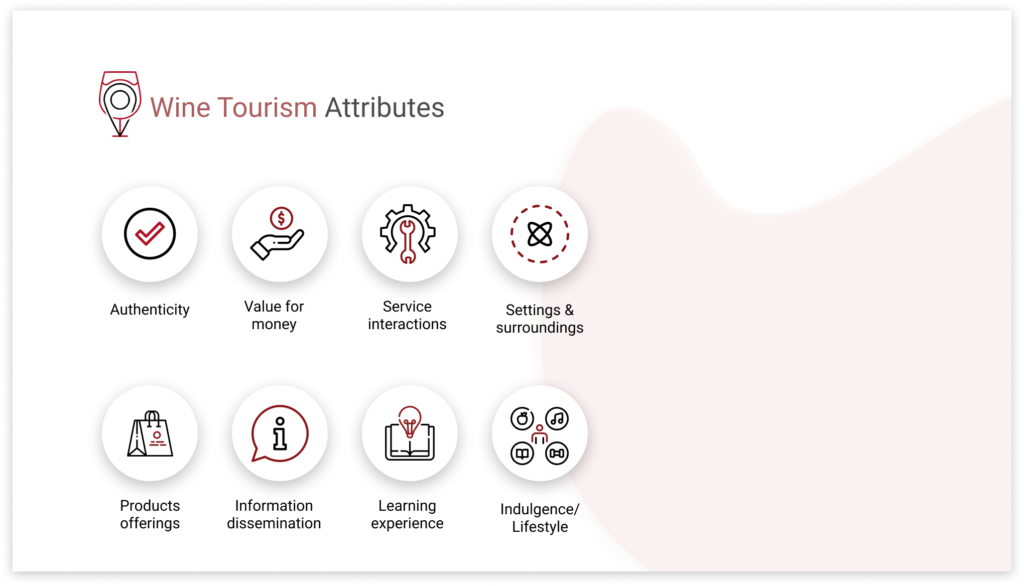

The authenticity of the experience
The authenticity attribute is the fact that wine tourists want to feel that the experience they are living is unique. Wine tourists want to feel they can really enjoy, learn something new, or, try new adventures. These experiences attributes often include typical gastronomy from the region, combined with unique wines that can only be purchased in that specific place. This uniqueness and realness feeling make wine tourists feel more appreciative of being part of that wine experience, more authentic and worthy.

Value for money
As the name suggests, wine tourists want to feel that their investment in a wine experience was worth the money they paid. Don’t we all want that feeling in every purchase we make? For wine tourism visitors it is actually one of the most relevant attributes. If the value for money is not clear enough for a wine tourist, the probability he or she recommends it to someone is almost non-existent. For some visitors, it may be represented as a complimentary wine tasting, the offer of a wine glass, or a “cooler pack” for a beverage.

Service interactions
There is a well-known expression that says “People is what makes a company”. Indeed, winemakers must be aware of that. No one enjoys going on an experience and feel like they are not being welcomed as they should. Therefore, every interaction between staff and customers must be ensured, either it is the welcome staff, guides, staff responsible for the wine tasting, and all the activities involved in the experience. In a nutshell, wine tourism workers must be trained, amicable, and most of all, highly available and professional. This dimension is considered even more valuable if personal and if the first contact was positive.

Settings & surroundings
An important factor described in the research of Roberts and Sparks (2006) is the environment of the experience. For example, the location, nature, surroundings, weather, and much more. Most wine tourism experiences include visits to vineyards, hiking, horse rides, cruise in the middle of a wine screaming environment. That means that both aesthetic surroundings (nature, well entertainment spaces, parks, mountains), as well as the weather, is often valued and measured before choosing for one or another wine tourism experience.

Products offerings
Who doesn’t like to receive presents? Just think about the happiness on everyone’s face during the last Christmas you’ve had. Or, your own happiness on your last birthday! Wine tourism experiences engage people, make them see new landscapes, taste new flavors, breathe new surroundings. But is that enough? The answer is a clear no. Additional features can and should be offered so the Wine cellar differentiates itself from others. Likewise, these offers can include wine tastings, local products, seasonal food, and information on the relation between wine and the proposed local products, nearby local activities, or typical restaurants. This addition to a wine experience is rare but very appreciated by the target. Which will increase the probability of the visitor recommending the experience to a friend or family.

Information dissemination
As stated before, wine tourists sometimes go on their wine journey by themselves, without guides or someone to ask for specific indications. Therefore, it is very important to guarantee there is enough signage across the winery, enough tools for tourists to adventure by themselves. Well explained information such as (1) Print media (newspapers and brochures); (2) have information centers; and (3) personal
information was given by the staff or others.

Learning experience
Visitors feel the need to learn while engaging in a wine tourism experience. Some tourists want to know how the wine cellar was born, others just want to know more about wine production, or even, about the wine country in which the cellar is inserted. Oenotourism is a different type of tourism activity, that includes several different realms: entertaining, educational, aesthetic, and, escapist. The education can be about the region, wine, winery history, wine production processes, relationship with food, and actually, everything that a tourist doesn’t know before the actual experience.
Indulgence/Lifestyle
Tourism and vacations go hand-to-hand. When we go on a tourism experience, we want most of all, forget about our daily boring lives. Indulgence, or lifestyle, attribute represents the desire that tourists have to have pleasing experiences. Thus, that helps them to separate from their work and city routine lives. This is a similar approach from the Escapist realm, included in the four realms of wine tourism.
After my experiences, I would add one attribute that would be the “surprise effect“. During the last few years, I have experienced some wine tourism activities. And, I concluded that most wine sellers focus on just tasting and walking through vineyards. I believe that being surprised is always something that gains our hearts and that surely makes us spread the word.
… A recent approach to Wine Tourism attributes
More recently, new research has been made on this subject. Authors such as Mauracher et al (2016) found that wine attributes in a wine experience are classified attributes. The wine tourism activities attributes were separated into:
- Quality of the wine attribute
- Price of the wine attribute
- Staff friendliness
- Competency attribute
- Overall visit to the winery

